


IVF vs ICSI: What’s the Difference and Who Might Need Each Treatment?
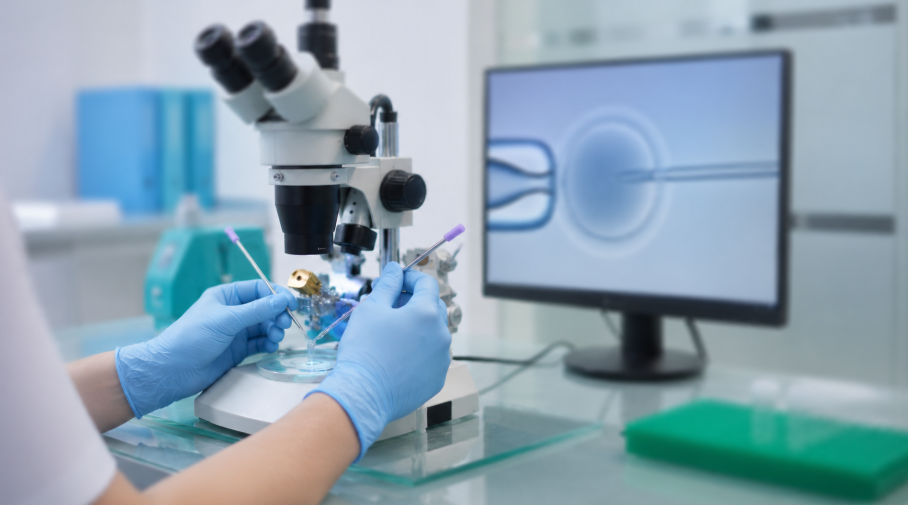
If you have been told that IVF might be the right next step, you may have also come across the term ICSI and wondered what sets the two apart. Both are forms of assisted reproductive technology, and both involve fertilising eggs in a laboratory setting. Beyond that, however, they differ in a way that matters clinically. Understanding the distinction can help you ask better questions and feel more confident in the conversations ahead.
This article explains how IVF and ICSI work, how they differ, and which circumstances typically point toward one over the other.
What Is IVF?
In vitro fertilisation (IVF) is one of the most established fertility treatments worldwide.
Following ovarian stimulation, eggs are retrieved from the ovaries and placed in a laboratory dish with specially prepared sperm. Fertilisation then occurs naturally in the laboratory, meaning the sperm find and penetrate the egg without direct assistance.
If fertilisation is successful, the resulting embryos are carefully monitored for several days, before one is selected for transfer to the uterus.
Conventional IVF is well suited to couples where sperm quality is within an acceptable range and there is no prior history of fertilisation failure.
What is ICSI?
Intracytoplasmic sperm injection, or ICSI, is a more targeted form of fertilisation that is performed as part of an IVF cycle.
Rather than allowing sperm to fertilise the egg naturally in a dish, an embryologist carefully selects a single sperm and injects it directly into the centre of a mature egg using highly specialised laboratory equipment. This bypasses the steps that sperm would normally need to complete on their own, including penetrating the outer layers of the egg.
The other stages of treatment, including ovarian stimulation, egg collection, embryo culture and embryo transfer, are the same as conventional IVF.
Developed in the early 1990s, ICSI transformed fertility treatment for many couples affected by severe male factor infertility by allowing fertilisation using a single carefully selected sperm.
The Key Differences Between IVF and ICSI
The stages before and after fertilisation are essentially the same in both treatments. The critical difference lies in how fertilisation itself takes place:
With conventional IVF:
- Eggs and prepared sperm are placed together in a laboratory dish.
- Fertilisation occurs naturally if a sperm successfully penetrates the egg.
With ICSI:
- An embryologist selects a single sperm.
- That sperm is injected directly into the egg using a microscopic needle.
Everything before and after fertilisation, including hormone treatment, egg collection, embryo development and embryo transfer, is essentially the same.
While ICSI can improve fertilisation rates in appropriately selected patients, particularly where male factor infertility is present, research has not shown that routinely using ICSI improves live birth rates for couples without male factor infertility. This is why the choice between the two is based on clinical indication rather than a general preference for one technique over the other.
Who is ICSI Recommended For?
ICSI was developed primarily to overcome male factor infertility, and this remains the preferred treatment in several situations. It is recommended in situations where the sperm's natural ability to fertilise an egg is compromised.
ICSI is typically recommended when:
- There is a low sperm count (oligospermia)
- Sperm motility is significantly reduced
- Sperm morphology is severely affected
- No sperm are present in the ejaculate (azoospermia), but sperm have been surgically retrieved from the testes or epididymis
- A previous IVF cycle resulted in failed or very low fertilisation
- Frozen sperm of limited quantity or quality are being used.
- Preimplantation genetic testing (PGT) is being performed alongside treatment
In cases of azoospermia, where no sperm are present in the ejaculate, surgically retrieved sperm can be used directly with ICSI. This includes sperm obtained through procedures such as TESA (testicular sperm aspiration) or TESE (testicular sperm extraction). Without ICSI, this sperm would not be suitable for conventional IVF.
When Is Conventional IVF Appropriate?
Conventional IVF remains the appropriate first-line option for many couples.
It is commonly used when sperm parameters are within normal range and there is no history of fertilisation failure. It is well established as an effective treatment for blocked fallopian tubes, ovulation disorders, endometriosis-related infertility, and unexplained infertility.
Current evidence suggests that routinely replacing IVF with ICSI in these situations does not improve the likelihood of having a baby. Instead, treatment should always be tailored to the specific fertility factors affecting each couple.
Is One Treatment Better Than the Other?
Neither IVF nor ICSI is universally superior. The right treatment depends on why conception has not occurred naturally, and what the clinical assessment reveals about both partners. A specialist will recommend the approach most likely to result in a successful outcome based on the results of a thorough fertility evaluation.
Success rates for both treatments are influenced significantly by age, egg and sperm quality, uterine health, and the presence of any underlying conditions. These factors are assessed as part of the initial fertility workup and taken into account when designing a treatment plan.
How We Approach Treatment Decisions
At Child Fertility, we do not apply a standard approach to every couple. Both IVF and ICSI are available as part of our treatment offering, and the recommendation for one over the other is made on the basis of a complete clinical assessment of both partners.
Our team takes the time to explain the reasoning behind any recommendation, so that you understand not just what is being proposed but why it is the most appropriate option for your situation.
Getting the Right Advice
If you have questions about IVF, ICSI, or which treatment may be right for you, the most important step is speaking with a specialist who can review your full situation. General information is useful for building understanding, but treatment decisions should always be based on a personalised assessment.
We welcome enquiries from couples at any stage of their fertility journey.
Frequently Asked Questions
1. Is ICSI more successful than IVF?
ICSI is not automatically more successful than conventional IVF. It is a specialised fertilisation technique designed for specific situations, particularly male factor infertility. The most suitable option depends on factors such as sperm quality, egg health, age, and the couple’s individual fertility circumstances.
2. Can I choose ICSI instead of IVF?
The decision between IVF and ICSI is usually based on a fertility specialist’s assessment rather than personal preference alone. While ICSI can be beneficial in certain cases, it is not necessary or recommended for every couple undergoing fertility treatment.
3. What is the main difference between IVF and ICSI?
The main difference is how fertilisation occurs. In conventional IVF, eggs and sperm are placed together in a laboratory dish and fertilisation occurs naturally. In ICSI, a single sperm is selected and injected directly into the egg by an embryologist to assist fertilisation.
4. Who is more likely to need ICSI treatment?
ICSI is commonly recommended for couples affected by male factor infertility, including low sperm count, poor sperm movement, abnormal sperm shape, surgically retrieved sperm, or previous IVF fertilisation failure.
5. Are the IVF and ICSI treatment processes different?
The stages before and after fertilisation are largely the same. Both treatments involve ovarian stimulation, egg retrieval, embryo development in the laboratory, and embryo transfer. The main difference occurs during the fertilisation stage itself.